Most people would find the picture of our universe as an infinite tower of tortoises rather ridiculous, but why do we think we know better? What do we know about the universe, and how do we know it? Where did the universe come from, and where is it going? Did the universe have a beginning, and if so, what happened before then? What is the nature of time? Will it ever come to an end? Can we go back in time? Recent breakthroughs in physics, made possible in part by fantastic new technologies, suggest answers to some of these longstanding questions. Someday these answers may seem as obvious to us as the earth orbiting the sun – or perhaps as ridiculous as a tower of tortoises. Only time (whatever that may be) will tell.
As long ago as 340 BC the Greek philosopher Aristotle, in his book On the Heavens, was able to put forward two good arguments for believing that the earth was a round sphere rather than a Hat plate. First, he realized that eclipses of the moon were caused by the earth coming between the sun and the moon. The earth’s shadow on the moon was always round, which would be true only if the earth was spherical. If the earth had been a flat disk, the shadow would have been elongated and elliptical, unless the eclipse always occurred at a time when the sun was directly under the center of the disk. Second, the Greeks knew from their travels that the North Star appeared lower in the sky when viewed in the south than it did in more northerly regions. (Since the North Star lies over the North Pole, it appears to be directly above an observer at the North Pole, but to someone looking from the equator, it appears to lie just at the horizon. From the difference in the apparent position of the North Star in Egypt and Greece, Aristotle even quoted an estimate that the distance around the earth was 400,000 stadia. It is not known exactly what length a stadium was, but it may have been about 200 yards, which would make Aristotle’s estimate about twice the currently accepted figure. The Greeks even had a third argument that the earth must be round, for why else does one first see the sails of a ship coming over the horizon, and only later see the hull?
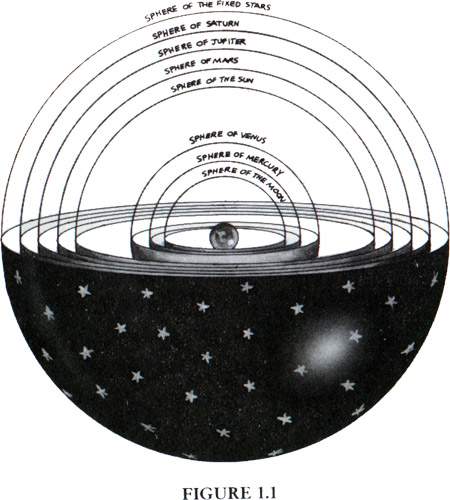 Aristotle thought the earth was
stationary and that the sun, the moon, the planets, and the stars moved in
circular orbits about the earth. He believed this because he felt, for mystical
reasons, that the earth was the center of the universe, and that circular
motion was the most perfect. This idea was elaborated by Ptolemy in the second
century AD into a complete cosmological model. The earth stood at the center,
surrounded by eight spheres that carried the moon, the sun, the stars, and the
five planets known at the time, Mercury, Venus, Mars, Jupiter, and Saturn (Fig.
1.1). The planets themselves moved on smaller circles attached to their
respective spheres in order to account for their rather complicated observed
paths in the sky. The outermost sphere carried the so-called fixed stars, which
always stay in the same positions relative to each other but which rotate
together across the sky. What lay beyond the last sphere was never made very
clear, but it certainly was not part of mankind’s observable universe.
Aristotle thought the earth was
stationary and that the sun, the moon, the planets, and the stars moved in
circular orbits about the earth. He believed this because he felt, for mystical
reasons, that the earth was the center of the universe, and that circular
motion was the most perfect. This idea was elaborated by Ptolemy in the second
century AD into a complete cosmological model. The earth stood at the center,
surrounded by eight spheres that carried the moon, the sun, the stars, and the
five planets known at the time, Mercury, Venus, Mars, Jupiter, and Saturn (Fig.
1.1). The planets themselves moved on smaller circles attached to their
respective spheres in order to account for their rather complicated observed
paths in the sky. The outermost sphere carried the so-called fixed stars, which
always stay in the same positions relative to each other but which rotate
together across the sky. What lay beyond the last sphere was never made very
clear, but it certainly was not part of mankind’s observable universe.Ptolemy’s model provided a reasonably accurate system for predicting the positions of heavenly bodies in the sky. But in order to predict these positions correctly, Ptolemy had to make an assumption that the moon followed a path that sometimes brought it twice as close to the earth as at other times. And that meant that the moon ought sometimes to appear twice as big as at other times! Ptolemy recognized this flaw, but nevertheless his model was generally, although not universally, accepted. It was adopted by the Christian church as the picture of the universe that was in accordance with Scripture, for it had the great advantage that it left lots of room outside the sphere of fixed stars for heaven and hell.
A simpler model, however, was proposed in 1514 by a Polish priest, Nicholas Copernicus. (At first, perhaps for fear of being branded a heretic by his church, Copernicus circulated his model anonymously.) His idea was that the sun was stationary at the center and that the earth and the planets moved in circular orbits around the sun. Nearly a century passed before this idea was taken seriously. Then two astronomers – the German, Johannes Kepler, and the Italian, Galileo Galilei – started publicly to support the Copernican theory, despite the fact that the orbits it predicted did not quite match the ones observed. The death blow to the Aristotelian/Ptolemaic theory came in 1609. In that year, Galileo started observing the night sky with a telescope, which had just been invented. When he looked at the planet Jupiter, Galileo found that it was accompanied by several small satellites or moons that orbited around it. This implied that everything did not have to orbit directly around the earth, as Aristotle and Ptolemy had thought. (It was, of course, still possible to believe that the earth was stationary at the center of the universe and that the moons of Jupiter moved on extremely complicated paths around the earth, giving the appearance that they orbited Jupiter. However, Copernicus’s theory was much simpler.) At the same time, Johannes Kepler had modified Copernicus’s theory, suggesting that the planets moved not in circles but in ellipses (an ellipse is an elongated circle). The predictions now finally matched the observations.
As far as Kepler was concerned, elliptical orbits were merely an ad hoc hypothesis, and a rather repugnant one at that, because ellipses were clearly less perfect than circles. Having discovered almost by accident that elliptical orbits fit the observations well, he could not reconcile them with his idea that the planets were made to orbit the sun by magnetic forces. An explanation was provided only much later, in 1687, when Sir Isaac Newton published his Philosophiae Naturalis Principia Mathematica, probably the most important single work ever published in the physical sciences. In it Newton not only put forward a theory of how bodies move in space and time, but he also developed the complicated mathematics needed to analyze those motions. In addition, Newton postulated a law of universal gravitation according to which each body in the universe was attracted toward every other body by a force that was stronger the more massive the bodies and the closer they were to each other. It was this same force that caused objects to fall to the ground. (The story that Newton was inspired by an apple hitting his head is almost certainly apocryphal. All Newton himself ever said was that the idea of gravity came to him as he sat “in a contemplative mood” and “was occasioned by the fall of an apple.”) Newton went on to show that, according to his law, gravity causes the moon to move in an elliptical orbit around the earth and causes the earth and the planets to follow elliptical paths around the sun.
The Copernican model got rid of Ptolemy’s celestial spheres, and with them, the idea that the universe had a natural boundary. Since “fixed stars” did not appear to change their positions apart from a rotation across the sky caused by the earth spinning on its axis, it became natural to suppose that the fixed stars were objects like our sun but very much farther away.
Newton realized that, according to his theory of gravity, the stars should attract each other, so it seemed they could not remain essentially motionless. Would they not all fall together at some point? In a letter in 1691 to Richard Bentley, another leading thinker of his day, Newton argued that this would indeed happen if there were only a finite number of stars distributed over a finite region of space. But he reasoned that if, on the other hand, there were an infinite number of stars, distributed more or less uniformly over infinite space, this would not happen, because there would not be any central point for them to fall to.
This argument is an instance of the pitfalls that you can encounter in talking about infinity. In an infinite universe, every point can be regarded as the center, because every point has an infinite number of stars on each side of it. The correct approach, it was realized only much later, is to consider the finite situation, in which the stars all fall in on each other, and then to ask how things change if one adds more stars roughly uniformly distributed outside this region. According to Newton’s law, the extra stars would make no difference at all to the original ones on average, so the stars would fall in just as fast. We can add as many stars as we like, but they will still always collapse in on them-selves. We now know it is impossible to have an infinite static model of the universe in which gravity is always attractive.
It is an interesting reflection on the general climate of thought before the twentieth century that no one had suggested that the universe was expanding or contracting. It was generally accepted that either the universe had existed forever in an unchanging state, or that it had been created at a finite time in the past more or less as we observe it today. In part this may have been due to people’s tendency to believe in eternal truths, as well as the comfort they found in the thought that even though they may grow old and die, the universe is eternal and unchanging.
Even those who realized that Newton’s theory of gravity showed that the universe could not be static did not think to suggest that it might be expanding. Instead, they attempted to modify the theory by making the gravitational force repulsive at very large distances. This did not significantly affect their predictions of the motions of the planets, but it allowed an infinite distribution of stars to remain in equilibrium – with the attractive forces between nearby stars balanced by the repulsive forces from those that were farther away. However, we now believe such an equilibrium would be unstable: if the stars in some region got only slightly nearer each other, the attractive forces between them would become stronger and dominate over the repulsive forces so that the stars would continue to fall toward each other. On the other hand, if the stars got a bit farther away from each other, the repulsive forces would dominate and drive them farther apart.
Another objection to an infinite static universe is normally ascribed to the German philosopher Heinrich Olbers, who wrote about this theory in 1823. In fact, various contemporaries of Newton had raised the problem, and the Olbers article was not even the first to contain plausible arguments against it. It was, however, the first to be widely noted. The difficulty is that in an infinite static universe nearly every line of sight would end on the surface of a star. Thus one would expect that the whole sky would be as bright as the sun, even at night. Olbers’ counter-argument was that the light from distant stars would be dimmed by absorption by intervening matter. However, if that happened the intervening matter would eventually heat up until it glowed as brightly as the stars. The only way of avoiding the conclusion that the whole of the night sky should be as bright as the surface of the sun would be to assume that the stars had not been shining forever but had turned on at some finite time in the past. In that case the absorbing matter might not have heated up yet or the light from distant stars might not yet have reached us. And that brings us to the question of what could have caused the stars to have turned on in the first place.
The beginning of the universe had, of course, been discussed long before this. According to a number of early cosmologies and the Jewish/Christian/Muslim tradition, the universe started at a finite, and not very distant, time in the past. One argument for such a beginning was the feeling that it was necessary to have “First Cause” to explain the existence of the universe. (Within the universe, you always explained one event as being caused by some earlier event, but the existence of the universe itself could be explained in this way only if it had some beginning.) Another argument was put forward by St. Augustine in his book The City of God. He pointed out that civilization is progressing and we remember who performed this deed or developed that technique. Thus man, and so also perhaps the universe, could not have been around all that long. St. Augustine accepted a date of about 5000 BC for the Creation of the universe according to the book of Genesis. (It is interesting that this is not so far from the end of the last Ice Age, about 10,000 BC, which is when archaeologists tell us that civilization really began.)
Aristotle, and most of the other Greek philosophers, on the other hand, did not like the idea of a creation because it smacked too much of divine intervention. They believed, therefore, that the human race and the world around it had existed, and would exist, forever. The ancients had already considered the argument about progress described above, and answered it by saying that there had been periodic floods or other disasters that repeatedly set the human race right back to the beginning of civilization.
The questions of whether the universe had a beginning in time and whether it is limited in space were later extensively examined by the philosopher Immanuel Kant in his monumental (and very obscure) work Critique of Pure Reason, published in 1781. He called these questions antinomies (that is, contradictions) of pure reason because he felt that there were equally compelling arguments for believing the thesis, that the universe had a beginning, and the antithesis, that it had existed forever. His argument for the thesis was that if the universe did not have a beginning, there would be an infinite period of time before any event, which he considered absurd. The argument for the antithesis was that if the universe had a beginning, there would be an infinite period of time before it, so why should the universe begin at any one particular time? In fact, his cases for both the thesis and the antithesis are really the same argument. They are both based on his unspoken assumption that time continues back forever, whether or not the universe had existed forever. As we shall see, the concept of time has no meaning before the beginning of the universe. This was first pointed out by St. Augustine. When asked: “What did God do before he created the universe?” Augustine didn’t reply: “He was preparing Hell for people who asked such questions.” Instead, he said that time was a property of the universe that God created, and that time did not exist before the beginning of the universe.
When most people believed in an essentially static and unchanging universe, the question of whether or not it had a beginning was really one of metaphysics or theology. One could account for what was observed equally well on the theory that the universe had existed forever or on the theory that it was set in motion at some finite time in such a manner as to look as though it had existed forever. But in 1929, Edwin Hubble made the landmark observation that wherever you look, distant galaxies are moving rapidly away from us. In other words, the universe is expanding. This means that at earlier times objects would have been closer together. In fact, it seemed that there was a time, about ten or twenty thousand million years ago, when they were all at exactly the same place and when, therefore, the density of the universe was infinite. This discovery finally brought the question of the beginning of the universe into the realm of science.
Hubble’s observations suggested that there was a time, called the big bang, when the universe was infinitesimally small and infinitely dense. Under such conditions all the laws of science, and therefore all ability to predict the future, would break down. If there were events earlier than this time, then they could not affect what happens at the present time. Their existence can be ignored because it would have no observational consequences. One may say that time had a beginning at the big bang, in the sense that earlier times simply would not be defined. It should be emphasized that this beginning in time is very different from those that had been considered previously. In an unchanging universe a beginning in time is something that has to be imposed by some being outside the universe; there is no physical necessity for a beginning. One can imagine that God created the universe at literally any time in the past. On the other hand, if the universe is expanding, there may be physical reasons why there had to be a beginning. One could still imagine that God created the universe at the instant of the big bang, or even afterwards in just such a way as to make it look as though there had been a big bang, but it would be meaningless to suppose that it was created before the big bang. An expanding universe does not preclude a creator, but it does place limits on when he might have carried out his job!
In order to talk about the nature of the universe and to discuss questions such as whether it has a beginning or an end, you have to be clear about what a scientific theory is. I shall take the simpleminded view that a theory is just a model of the universe, or a restricted part of it, and a set of rules that relate quantities in the model to observations that we make. It exists only in our minds and does not have any other reality (whatever that might mean). A theory is a good theory if it satisfies two requirements. It must accurately describe a large class of observations on the basis of a model that contains only a few arbitrary elements, and it must make definite predictions about the results of future observations. For example, Aristotle believed Empedocles’s theory that everything was made out of four elements, earth, air, fire, and water. This was simple enough, but did not make any definite predictions. On the other hand, Newton’s theory of gravity was based on an even simpler model, in which bodies attracted each other with a force that was proportional to a quantity called their mass and inversely proportional to the square of the distance between them. Yet it predicts the motions of the sun, the moon, and the planets to a high degree of accuracy.
Any physical theory is always provisional, in the sense that it is only a hypothesis: you can never prove it. No matter how many times the results of experiments agree with some theory, you can never be sure that the next time the result will not contradict the theory. On the other hand, you can disprove a theory by finding even a single observation that disagrees with the predictions of the theory. As philosopher of science Karl Popper has emphasized, a good theory is characterized by the fact that it makes a number of predictions that could in principle be disproved or falsified by observation. Each time new experiments are observed to agree with the predictions the theory survives, and our confidence in it is increased; but if ever a new observation is found to disagree, we have to abandon or modify the theory. At least that is what is supposed to happen, but you can always question the competence of the person who carried out the observation. In practice, what often happens is that a new theory is devised that is really an extension of the previous theory. For example, very accurate observations of the planet Mercury revealed a small difference between its motion and the predictions of Newton’s theory of gravity. Einstein’s general theory of relativity predicted a slightly different motion from Newton’s theory. The fact that Einstein’s predictions matched what was seen, while Newton’s did not, was one of the crucial confirmations of the new theory. However, we still use Newton’s theory for all practical purposes because the difference between its predictions and those of general relativity is very small in the situations that we normally deal with. (Newton’s theory also has the great advantage that it is much simpler to work with than Einstein’s!)
The eventual goal of science is to provide a single theory that describes the whole universe. However, the approach most scientists actually follow is to separate the problem into two parts. First, there are the laws that tell us how the universe changes with time. (If we know what the universe is like at any one time, these physical laws tell us how it will look at any later time.) Second, there is the question of the initial state of the universe. Some people feel that science should be concerned with only the first part; they regard the question of the initial situation as a matter for metaphysics or religion. They would say that God, being omnipotent, could have started the universe off any way he wanted. That may be so, but in that case he also could have made it develop in a completely arbitrary way. Yet it appears that he chose to make it evolve in a very regular way according to certain laws. It therefore seems equally reasonable to suppose that there are also laws governing the initial state.
It turns out to be very difficult to devise a theory to describe the universe all in one go. Instead, we break the problem up into bits and invent a number of partial theories. Each of these partial theories describes and predicts a certain limited class of observations, neglecting the effects of other quantities, or representing them by simple sets of numbers. It may be that this approach is completely wrong. If every-thing in the universe depends on everything else in a fundamental way, it might be impossible to get close to a full solution by investigating parts of the problem in isolation. Nevertheless, it is certainly the way that we have made progress in the past. The classic example again is the Newtonian theory of gravity, which tells us that the gravitational force between two bodies depends only on one number associated with each body, its mass, but is otherwise independent of what the bodies are made of. Thus one does not need to have a theory of the structure and constitution of the sun and the planets in order to calculate their orbits.
Today scientists describe the universe in terms of two basic partial theories – the general theory of relativity and quantum mechanics. They are the great intellectual achievements of the first half of this century. The general theory of relativity describes the force of gravity and the large-scale structure of the universe, that is, the structure on scales from only a few miles to as large as a million million million million (1 with twenty-four zeros after it) miles, the size of the observable universe. Quantum mechanics, on the other hand, deals with phenomena on extremely small scales, such as a millionth of a millionth of an inch. Unfortunately, however, these two theories are known to be inconsistent with each other – they cannot both be correct. One of the major endeavors in physics today, and the major theme of this book, is the search for a new theory that will incorporate them both – a quantum theory of gravity. We do not yet have such a theory, and we may still be a long way from having one, but we do already know many of the properties that it must have. And we shall see, in later chapters, that we already know a fair amount about the predications a quantum theory of gravity must make.
Now, if you believe that the universe is not arbitrary, but is governed by definite laws, you ultimately have to combine the partial theories into a complete unified theory that will describe everything in the universe. But there is a fundamental paradox in the search for such a complete unified theory. The ideas about scientific theories outlined above assume we are rational beings who are free to observe the universe as we want and to draw logical deductions from what we see.
In such a scheme it is reasonable to suppose that we might progress ever closer toward the laws that govern our universe. Yet if there really is a complete unified theory, it would also presumably determine our actions. And so the theory itself would determine the outcome of our search for it! And why should it determine that we come to the right conclusions from the evidence? Might it not equally well determine that we draw the wrong conclusion.? Or no conclusion at all?
The only answer that I can give to this problem is based on Darwin’s principle of natural selection. The idea is that in any population of self-reproducing organisms, there will be variations in the genetic material and upbringing that different individuals have. These differences will mean that some individuals are better able than others to draw the right conclusions about the world around them and to act accordingly. These individuals will be more likely to survive and reproduce and so their pattern of behavior and thought will come to dominate. It has certainly been true in the past that what we call intelligence and scientific discovery have conveyed a survival advantage. It is not so clear that this is still the case: our scientific discoveries may well destroy us all, and even if they don’t, a complete unified theory may not make much difference to our chances of survival. However, provided the universe has evolved in a regular way, we might expect that the reasoning abilities that natural selection has given us would be valid also in our search for a complete unified theory, and so would not lead us to the wrong conclusions.
Because the partial theories that we already have are sufficient to make accurate predictions in all but the most extreme situations, the search for the ultimate theory of the universe seems difficult to justify on practical grounds. (It is worth noting, though, that similar arguments could have been used against both relativity and quantum mechanics, and these theories have given us both nuclear energy and the microelectronics revolution!) The discovery of a complete unified theory, therefore, may not aid the survival of our species. It may not even affect our life-style. But ever since the dawn of civilization, people have not been content to see events as unconnected and inexplicable. They have craved an understanding of the underlying order in the world. Today we still yearn to know why we are here and where we came from. Humanity’s deepest desire for knowledge is justification enough for our continuing quest. And our goal is nothing less than a complete description of the universe we live in.