CHAPTER 8
THE ORIGIN AND FATE OF THE UNIVERSE
Einstein’s general theory of
relativity, on its own, predicted that space-time began at the big bang
singularity and would come to an end either at the big crunch singularity (if
the whole universe recollapsed), or at a singularity inside a black hole (if a
local region, such as a star, were to collapse). Any matter that fell into the
hole would be destroyed at the singularity, and only the gravitational effect
of its mass would continue to be felt outside. On the other hand, when quantum
effects were taken into account, it seemed that the mass or energy of the matter
would eventually be returned to the rest of the universe, and that the black
hole, along with any singularity inside it, would evaporate away and finally
disappear. Could quantum mechanics have an equally dramatic effect on the big
bang and big crunch singularities? What really happens during the very early or
late stages of the universe, when gravitational fields are so strong that
quantum effects cannot be ignored? Does the universe in fact have a beginning
or an end? And if so, what are they like?
Throughout the 1970s I had been
mainly studying black holes, but in 1981 my interest in questions about the
origin and fate of the universe was reawakened when I attended a conference on
cosmology organized by the Jesuits in the Vatican. The Catholic Church had made
a bad mistake with Galileo when it tried to lay down the law on a question of
science, declaring that the sun went round the earth. Now, centuries later, it
had decided to invite a number of experts to advise it on cosmology. At the end
of the conference the participants were granted an audience with the Pope. He
told us that it was all right to study the evolution of the universe after the
big bang, but we should not inquire into the big bang itself because that was
the moment of Creation and therefore the work of God. I was glad then that he
did not know the subject of the talk I had just given at the conference – the
possibility that space-time was finite but had no boundary, which means that it
had no beginning, no moment of Creation. I had no desire to share the fate of
Galileo, with whom I feel a strong sense of identity, partly because of the
coincidence of having been born exactly 300 years after his death!
In order to
explain the ideas that I and other people have had about how quantum mechanics
may affect the origin and fate of the universe, it is necessary first to
understand the generally accepted history of the universe, according to what is
known as the “hot big bang model.” This assumes that the universe is described
by a Friedmann model, right back to the big bang. In such models one finds that
as the universe expands, any matter or radiation in it gets cooler. (When the
universe doubles in size, its temperature falls by half.) Since temperature is
simply a measure of the average energy – or speed – of the particles, this
cooling of the universe would have a major effect on the matter in it. At very
high temperatures, particles would be moving around so fast that they could
escape any attraction toward each other due to nuclear or electromagnetic
forces, but as they cooled off one would expect particles that attract each
other to start to clump together. Moreover, even the types of particles that
exist in the universe would depend on the temperature. At high enough
temperatures, particles have so much energy that whenever they collide many
different particle/antiparticle pairs would be produced – and although some of
these particles would annihilate on hitting antiparticles, they would be
produced more rap-idly than they could annihilate. At lower temperatures,
however, when colliding particles have less energy, particle/antiparticle pairs
would be produced less quickly – and annihilation would become faster than
production.
At the big bang
itself the universe is thought to have had zero size, and so to have been
infinitely hot. But as the universe expanded, the temperature of the radiation
decreased. One second after the big bang, it would have fallen to about ten
thousand million degrees. This is about a thousand times the temperature at the
center of the sun, but temperatures as high as this are reached in H-bomb
explosions. At this time the universe would have contained mostly photons,
electrons, and neutrinos (extremely light particles that are affected only by
the weak force and gravity) and their antiparticles, together with some protons
and neutrons. As the universe continued to expand and the temperature to drop,
the rate at which electron/antielectron pairs were being produced in collisions
would have fallen below the rate at which they were being destroyed by
annihilation. So most of the electrons and antielectrons would have annihilated
with each other to produce more photons, leaving only a few electrons left
over. The neutrinos and antineutrinos, however, would not have annihilated with
each other, because these particles interact with themselves and with other
particles only very weakly. So they should still be around today. If we could
observe them, it would provide a good test of this picture of a very hot early
stage of the universe. Unfortunately, their energies nowadays would be too low
for us to observe them directly. However, if neutrinos are not massless, but
have a small mass of their own, as suggested by some recent experiments, we
might be able to detect them indirectly: they could be a form of “dark matter,”
like that mentioned earlier, with sufficient gravitational attraction to stop
the expansion of the universe and cause it to collapse again.
About one hundred seconds after the big bang, the
temperature would have fallen to one thousand million degrees, the temperature
inside the hottest stars. At this temperature protons and neutrons would no
longer have sufficient energy to escape the attraction of the strong nuclear
force, and would have started to combine together to produce the nuclei of
atoms of deuterium (heavy hydrogen), which contain one proton and one neutron.
The deuterium nuclei would then have combined with more protons and neutrons to
make helium nuclei, which contain two protons and two neutrons, and also small
amounts of a couple of heavier elements, lithium and beryllium. One can
calculate that in the hot big bang model about a quarter of the protons and
neutrons would have been converted into helium nuclei, along with a small
amount of heavy hydrogen and other elements. The remaining neutrons would have
decayed into protons, which are the nuclei of ordinary hydrogen atoms.
This picture of
a hot early stage of the universe was first put forward by the scientist George
Gamow in a famous paper written in 1948 with a student of his, Ralph Alpher.
Gamow had quite a sense of humor – he persuaded the nuclear scientist Hans
Bethe to add his name to the paper to make the list of authors “Alpher, Bethe,
Gamow,” like the first three letters of the Greek alphabet, alpha, beta, gamma:
particularly appropriate for a paper on the beginning of the universe! In this
paper they made the remarkable prediction that radiation (in the form of
photons) from the very hot early stages of the universe should still be around
today, but with its temperature reduced to only a few degrees above absolute
zero (–273ºC). It was this radiation that Penzias and Wilson found in
1965. At the time that Alpher, Bethe, and Gamow wrote their paper, not much was
known about the nuclear reactions of protons and neutrons. Predictions made for
the proportions of various elements in the early universe were therefore rather
inaccurate, but these calculations have been repeated in the light of better
knowledge and now agree very well with what we observe. It is, moreover, very
difficult to explain in any other way why there should be so much helium in the
universe. We are therefore fairly confident that we have the right picture, at
least back to about one second after the big bang.
Within only a
few hours of the big bang, the production of helium and other elements would
have stopped. And after that, for the next million years or so, the universe
would have just continued expanding, without anything much happening.
Eventually, once the temperature had dropped to a few thousand degrees, and
electrons and nuclei no longer had enough energy to overcome the
electromagnetic attraction between them, they would have started combining to
form atoms. The universe as a whole would have continued expanding and cooling,
but in regions that were slightly denser than average, the expansion would have
been slowed down by the extra gravitational attraction. This would eventually
stop expansion in some regions and cause them to start to recollapse. As they
were collapsing, the gravitational pull of matter outside these regions might
start them rotating slightly. As the collapsing region got smaller, it would
spin faster – just as skaters spinning on ice spin faster as they draw in their
arms. Eventually, when the region got small enough, it would be spinning fast
enough to balance the attraction of gravity, and in this way disklike rotating
galaxies were born. Other regions, which did not happen to pick up a rotation,
would become oval-shaped objects called elliptical galaxies. In these, the
region would stop collapsing because individual parts of the galaxy would be
orbiting stably round its center, but the galaxy would have no overall
rotation.
As time went
on, the hydrogen and helium gas in the galaxies would break up into smaller
clouds that would collapse under their own gravity. As these contracted, and
the atoms within them collided with one another, the temperature of the gas
would increase, until eventually it became hot enough to start nuclear fusion
reactions. These would convert the hydrogen into more helium, and the heat
given off would raise the pressure, and so stop the clouds from contracting any
further. They would remain stable in this state for a long time as stars like
our sun, burning hydrogen into helium and radiating the resulting energy as
heat and light. More massive stars would need to be hotter to balance their
stronger gravitational attraction, making the nuclear fusion reactions proceed
so much more rapidly that they would use up their hydrogen in as little as a
hundred million years. They would then contract slightly, and as they heated up
further, would start to convert helium into heavier elements like carbon or
oxygen. This, however, would not release much more energy, so a crisis would
occur, as was described in the chapter on black holes. What happens next is not
completely clear, but it seems likely that the central regions of the star
would collapse to a very dense state, such as a neutron star or black hole. The
outer regions of the star may sometimes get blown off in a tremendous explosion
called a supernova, which would outshine all the other stars in its galaxy.
Some of the heavier elements produced near the end of the star’s life would be
flung back into the gas in the galaxy, and would provide some of the raw
material for the next generation of stars. Our own sun contains about 2 percent
of these heavier elements, because it is a second- or third-generation star,
formed some five thousand million years ago out of a cloud of rotating gas
containing the debris of earlier supernovas. Most of the gas in that cloud went
to form the sun or got blown away, but a small amount of the heavier elements
collected together to form the bodies that now orbit the sun as planets like
the earth.
The earth was initially very hot and without an
atmosphere. In the course of time it cooled and acquired an atmosphere from the
emission of gases from the rocks. This early atmosphere was not one in which we
could have survived. It contained no oxygen, but a lot of other gases that are
poisonous to us, such as hydrogen sulfide (the gas that gives rotten eggs their
smell). There are, however, other primitive forms of life that can flourish
under such conditions. It is thought that they developed in the oceans,
possibly as a result of chance combinations of atoms into large structures,
called macromolecules, which were capable of assembling other atoms in the
ocean into similar structures. They would thus have reproduced themselves and
multiplied. In some cases there would be errors in the reproduction. Mostly
these errors would have been such that the new macromolecule could not
reproduce itself and eventually would have been destroyed. However, a few of
the errors would have produced new macromolecules that were even better at
reproducing themselves. They would have therefore had an advantage and would
have tended to replace the original macromolecules. In this way a process of
evolution was started that led to the development of more and more complicated,
self-reproducing organisms. The first primitive forms of life consumed various
materials, including hydrogen sulfide, and released oxygen. This gradually
changed the atmosphere to the composition that it has today, and allowed the
development of higher forms of life such as fish, reptiles, mammals, and
ultimately the human race.
This picture of
a universe that started off very hot and cooled as it expanded is in agreement
with all the observational evidence that we have today. Nevertheless, it leaves
a number of important questions unanswered:
1. Why was the early universe so hot?
2. Why is the universe so uniform on a large scale? Why does it look
the same at all points of space and in all directions? In particular, why is
the temperature of the microwave back-ground radiation so nearly the same when
we look in different directions? It is a bit like asking a number of students
an exam question. If they all give exactly the same answer, you can be pretty
sure they have communicated with each other. Yet, in the model described above,
there would not have been time since the big bang for light to get from one
distant region to another, even though the regions were close together in the
early universe. According to the theory of relativity, if light cannot get from
one region to another, no other information can. So there would be no way in
which different regions in the early universe could have come to have the same
temperature as each other, unless for some unexplained reason they happened to
start out with the same temperature.
3. Why did the universe start out with so nearly the critical
rate of expansion that separates models that recollapse from those that go on
expanding forever, that even now, ten thousand million years later, it is still
expanding at nearly the critical rate? If the rate of expansion one second
after the big bang had been smaller by even one part in a hundred thousand
million million, the universe would have recollapsed before it ever reached its
present size.
4. Despite the fact that the universe is so uniform and homogeneous on a
large scale, it contains local irregularities, such as stars and galaxies.
These are thought to have developed from small differences in the density of
the early universe from one region to another. What was the origin of these density
fluctuations?
The general
theory of relativity, on its own, cannot explain these features or answer these
questions because of its prediction that the universe started off with infinite
density at the big bang singularity. At the singularity, general relativity and
all other physical laws would break down: one couldn’t predict what would come
out of the singularity. As explained before, this means that one might as well
cut the big bang, and any events before it, out of the theory, because they can
have no effect on what we observe. Space-time would have a boundary – a
beginning at the big bang.
Science seems
to have uncovered a set of laws that, within the limits set by the uncertainty
principle, tell us how the universe will develop with time, if we know its
state at any one time. These laws may have originally been decreed by God, but
it appears that he has since left the universe to evolve according to them and
does not now intervene in it. But how did he choose the initial state or
configuration of the universe? What were the “boundary conditions” at the
beginning of time?
One possible
answer is to say that God chose the initial configuration of the universe for
reasons that we cannot hope to understand. This would certainly have been
within the power of an omnipotent being, but if he had started it off in such
an incomprehensible way, why did he choose to let it evolve according to laws
that we could understand? The whole history of science has been the gradual
realization that events do not happen in an arbitrary manner, but that they
reflect a certain underlying order, which may or may not be divinely inspired.
It would be only natural to suppose that this order should apply not only to
the laws, but also to the conditions at the boundary of space-time that specify
the initial state of the universe. There may be a large number of models of the
universe with different initial conditions that all obey the laws. There ought
to be some principle that picks out one initial state, and hence one model, to
represent our universe.
One such
possibility is what are called chaotic boundary conditions. These implicitly
assume either that the universe is spatially infinite or that there are
infinitely many universes. Under chaotic boundary conditions, the probability
of finding any particular region of space in any given configuration just after
the big bang is the same, in some sense, as the probability of finding it in
any other configuration: the initial state of the universe is chosen purely
randomly. This would mean that the early universe would have probably been very
chaotic and irregular because there are many more chaotic and disordered
configurations for the universe than there are smooth and ordered ones. (If
each configuration is equally probable, it is likely that the universe started
out in a chaotic and disordered state, simply because there are so many more of
them.) It is difficult to see how such chaotic initial conditions could have
given rise to a universe that is so smooth and regular on a large scale as ours
is today. One would also have expected the density fluctuations in such a model
to have led to the formation of many more primordial black holes than the upper
limit that has been set by observations of the gamma ray background.
If the universe is indeed
spatially infinite, or if there are infinitely many universes, there would
probably be some large regions somewhere that started out in a smooth and
uniform manner. It is a bit like the well-known horde of monkeys hammering away
on typewriters – most of what they write will be garbage, but very occasionally
by pure chance they will type out one of Shakespeare’s sonnets. Similarly, in
the case of the universe, could it be that we are living in a region that just
happens by chance to be smooth and uniform? At first sight this might seem very
improbable, because such smooth regions would be heavily outnumbered by chaotic
and irregular regions. However, suppose that only in the smooth regions were
galaxies and stars formed and were conditions right for the development of
complicated self-replicating organisms like ourselves who were capable of
asking the question: why is the universe so smooth.? This is an example of the
application of what is known as the anthropic principle, which can be
paraphrased as “We see the universe the way it is because we exist.”
There are two
versions of the anthropic principle, the weak and the strong. The weak anthropic
principle states that in a universe that is large or infinite in space and/or
time, the conditions necessary for the development of intelligent life will be
met only in certain regions that are limited in space and time. The intelligent
beings in these regions should therefore not be surprised if they observe that
their locality in the universe satisfies the conditions that are necessary for
their existence. It is a bit like a rich person living in a wealthy
neighborhood not seeing any poverty.
One example of
the use of the weak anthropic principle is to “explain” why the big bang
occurred about ten thousand million years ago – it takes about that long for
intelligent beings to evolve. As explained above, an early generation of stars
first had to form. These stars converted some of the original hydrogen and
helium into elements like carbon and oxygen, out of which we are made. The
stars then exploded as supernovas, and their debris went to form other stars
and planets, among them those of our Solar System, which is about five thousand
million years old. The first one or two thousand million years of the earth’s
existence were too hot for the development of anything complicated. The
remaining three thousand million years or so have been taken up by the slow
process of biological evolution, which has led from the simplest organisms to
beings who are capable of measuring time back to the big bang.
Few people
would quarrel with the validity or utility of the weak anthropic principle.
Some, however, go much further and propose a strong version of the principle.
According to this theory, there are either many different universes or many
different regions of a single universe, each with its own initial configuration
and, perhaps, with its own set of laws of science. In most of these universes
the conditions would not be right for the development of complicated organisms;
only in the few universes that are like ours would intelligent beings develop
and ask the question, “Why is the universe the way we see it?” The answer is
then simple: if it had been different, we would not be here!
The laws of
science, as we know them at present, contain many fundamental numbers, like the
size of the electric charge of the electron and the ratio of the masses of the
proton and the electron. We cannot, at the moment at least, predict the values
of these numbers from theory – we have to find them by observation. It may be
that one day we shall discover a complete unified theory that predicts them
all, but it is also possible that some or all of them vary from universe to
universe or within a single universe. The remarkable fact is that the values of
these numbers seem to have been very finely adjusted to make possible the
development of life. For example, if the electric charge of the electron had
been only slightly different, stars either would have been unable to burn
hydrogen and helium, or else they would not have exploded. Of course, there
might be other forms of intelligent life, not dreamed of even by writers of
science fiction, that did not require the light of a star like the sun or the
heavier chemical elements that are made in stars and are flung back into space
when the stars explode. Nevertheless, it seems clear that there are relatively
few ranges of values for the numbers that would allow the development of any
form of intelligent life. Most sets of values would give rise to universes
that, although they might be very beautiful, would contain no one able to
wonder at that beauty. One can take this either as evidence of a divine purpose
in Creation and the choice of the laws of science or as support for the strong
anthropic principle.
There are a
number of objections that one can raise to the strong anthropic principle as an
explanation of the observed state of the universe. First, in what sense can all
these different universes be said to exist? If they are really separate from
each other, what happens in another universe can have no observable
consequences in our own universe. We should therefore use the principle of
economy and cut them out of the theory. If, on the other hand, they are just
different regions of a single universe, the laws of science would have to be
the same in each region, because otherwise one could not move continuously from
one region to another. In this case the only difference between the regions
would be their initial configurations and so the strong anthropic principle
would reduce to the weak one.
A second objection to the strong anthropic
principle is that it runs against the tide of the whole history of science. We
have developed from the geocentric cosmologies of Ptolemy and his forebears,
through the heliocentric cosmology of Copernicus and Galileo, to the modern
picture in which the earth is a medium-sized planet orbiting around an average
star in the outer suburbs of an ordinary spiral galaxy, which is itself only
one of about a million million galaxies in the observable universe. Yet the
strong anthropic principle would claim that this whole vast construction exists
simply for our sake. This is very hard to believe. Our Solar System is
certainly a prerequisite for our existence, hand one might extend this to the
whole of our galaxy to allow for an earlier generation of stars that created
the heavier elements. But there does not seem to be any need for all those
other galaxies, nor for the universe to be so uniform and similar in every
direction on the large scale.
One would feel
happier about the anthropic principle, at least in its weak version, if one
could show that quite a number of different initial configurations for the
universe would have evolved to produce a universe like the one we observe. If
this is the case, a universe that developed from some sort of random initial
conditions should contain a number of regions that are smooth and uniform and
are suitable for the evolution of intelligent life. On the other hand, if the
initial state of the universe had to be chosen extremely carefully to lead to
something like what we see around us, the universe would be unlikely to contain
any region in which life would appear. In the hot big bang model described
above, there was not enough time in the early universe for heat to have flowed
from one region to another. This means that the initial state of the universe
would have to have had exactly the same temperature everywhere in order to
account for the fact that the microwave back-ground has the same temperature in
every direction we look. The initial rate of expansion also would have had to
be chosen very precisely for the rate of expansion still to be so close to the
critical rate needed to avoid recollapse. This means that the initial state of
the universe must have been very carefully chosen indeed if the hot big bang
model was correct right back to the beginning of time. It would be very difficult
to explain why the universe should have begun in just this way, except as the
act of a God who intended to create beings like us.
In an attempt
to find a model of the universe in which many different initial configurations
could have evolved to something like the present universe, a scientist at the
Massachusetts Institute of Technology, Alan Guth, suggested that the early
universe might have gone through a period of very rapid expansion. This
expansion is said to be “inflationary,” meaning that the universe at one time
expanded at an increasing rate rather than the decreasing rate that it does
today. According to Guth, the radius of the universe increased by a million
million million million million (1 with thirty zeros after it) times in only a
tiny fraction of a second.
Guth suggested
that the universe started out from the big bang in a very hot, but rather
chaotic, state. These high temperatures would have meant that the particles in
the universe would be moving very fast and would have high energies. As we
discussed earlier, one would expect that at such high temperatures the strong
and weak nuclear forces and the electromagnetic force would all be unified into
a single force. As the universe expanded, it would cool, and particle energies
would go down. Eventually there would be what is called a phase transition and
the symmetry between the forces would be broken: the strong force would become
different from the weak and electromagnetic forces. One common example of a
phase transition is the freezing of water when you cool it down. Liquid water
is symmetrical, the same at every point and in every direction. However, when
ice crystals form, they will have definite positions and will be lined up in
some direction. This breaks water’s symmetry.
In the case of
water, if one is careful, one can “supercool” it: that is, one can reduce the
temperature below the freezing point (OºC) without ice forming. Guth
suggested that the universe might behave in a similar way: the temperature
might drop below the critical value without the symmetry between the forces
being broken. If this happened, the universe would be in an unstable state,
with more energy than if the symmetry had been broken. This special extra
energy can be shown to have an antigravitational effect: it would have acted
just like the cosmological constant that Einstein introduced into general
relativity when he was trying to construct a static model of the universe.
Since the universe would already be expanding just as in the hot big bang
model, the repulsive effect of this cosmological constant would therefore have
made the universe expand at an ever-increasing rate. Even in regions where
there were more matter particles than average, the gravitational attraction of
the matter would have been outweighed by the repulsion of the effective
cosmological constant. Thus these regions would also expand in an accelerating
inflationary manner. As they expanded and the matter particles got farther
apart, one would be left with an expanding universe that contained hardly any
particles and was still in the supercooled state. Any irregularities in the
universe would simply have been smoothed out by the expansion, as the wrinkles
in a balloon are smoothed away when you blow it up. Thus the present smooth and
uniform state of the universe could have evolved from many different
non-uniform initial states.
In such a
universe, in which the expansion was accelerated by a cosmological constant
rather than slowed down by the gravitational attraction of matter, there would
be enough time for light to travel from one region to another in the early
universe. This could provide a solution to the problem, raised earlier, of why
different regions in the early universe have the same properties. Moreover, the
rate of expansion of the universe would automatically become very close to the
critical rate determined by the energy density of the universe. This could then
explain why the rate of expansion is still so close to the critical rate,
without having to assume that the initial rate of expansion of the universe was
very carefully chosen.
The idea of
inflation could also explain why there is so much matter in the universe. There
are something like ten million million million million million million million
million million million million million million million (1 with eighty zeros
after it) particles in the region of the universe that we can observe. Where
did they all come from? The answer is that, in quantum theory, particles can be
created out of energy in the form of particle/antiparticle pairs. But that just
raises the question of where the energy came from. The answer is that the total
energy of the universe is exactly zero. The matter in the universe is made out
of positive energy. However, the matter is all attracting itself by gravity.
Two pieces of matter that are close to each other have less energy than the
same two pieces a long way apart, because you have to expend energy to separate
them against the gravitational force that is pulling them together. Thus, in a
sense, the gravitational field has negative energy. In the case of a universe
that is approximately uniform in space, one can show that this negative
gravitational energy exactly cancels the positive energy represented by the
matter. So the total energy of the universe is zero.
Now twice zero
is also zero. Thus the universe can double the amount of positive matter energy
and also double the negative gravitational energy without violation of the
conservation of energy. This does not happen in the normal expansion of the
universe in which the matter energy density goes down as the universe gets
bigger. It does happen, however, in the inflationary expansion because the
energy density of the supercooled state remains constant while the universe
expands: when the universe doubles in size, the positive matter energy and the
negative gravitational energy both double, so the total energy remains zero.
During the inflationary phase, the universe increases its size by a very large
amount. Thus the total amount of energy available to make particles becomes
very large. As Guth has remarked, “It is said that there’s no such thing as a
free lunch. But the universe is the ultimate free lunch.”
The universe is
not expanding in an inflationary way today. Thus there has to be some mechanism
that would eliminate the very large effective cosmological constant and so
change the rate of expansion from an accelerated one to one that is slowed down
by gravity, as we have today. In the inflationary expansion one might expect
that eventually the symmetry between the forces would be broken, just as
super-cooled water always freezes in the end. The extra energy of the unbroken
symmetry state would then be released and would reheat the universe to a
temperature just below the critical temperature for symmetry between the
forces. The universe would then go on to expand and cool just like the hot big
bang model, but there would now be an explanation of why the universe was
expanding at exactly the critical rate and why different regions had the same
temperature.
In Guth’s
original proposal the phase transition was supposed to occur suddenly, rather
like the appearance of ice crystals in very cold water. The idea was that
“bubbles” of the new phase of broken symmetry would have formed in the old
phase, like bubbles of steam surrounded by boiling water. The bubbles were
supposed to expand and meet up with each other until the whole universe was in
the new phase. The trouble was, as I and several other people pointed out, that
the universe was expanding so fast that even if the bubbles grew at the speed
of light, they would be moving away from each other and so could not join up.
The universe would be left in a very non-uniform state, with some regions still
having symmetry between the different forces. Such a model of the universe
would not correspond to what we see.
In October
1981, I went to Moscow for a conference on quantum gravity. After the
conference I gave a seminar on the inflationary model and its problems at the
Sternberg Astronomical Institute. Before this, I had got someone else to give
my lectures for me, because most people could not understand my voice. But
there was not time to prepare this seminar, so I gave it myself, with one of my
graduate students repeating my words. It worked well, and gave me much more
contact with my audience. In the audience was a young Russian, Andrei Linde,
from the Lebedev Institute in Moscow. He said that the difficulty with the
bubbles not joining up could be avoided if the bubbles were so big that our
region of the universe is all contained inside a single bubble. In order for
this to work, the change from symmetry to broken symmetry must have taken place
very slowly inside the bubble, but this is quite possible according to grand
unified theories. Linde’s idea of a slow breaking of symmetry was very good,
but I later realized that his bubbles would have to have been bigger than the
size of the universe at the time! I showed that instead the symmetry would have
broken everywhere at the same time, rather than just inside bubbles. This would
lead to a uniform universe, as we observe. I was very excited by this idea and
discussed it with one of my students, Ian Moss. As a friend of Linde’s, I was
rather embarrassed, however, when I was later sent his paper by a scientific journal
and asked whether it was suitable for publication. I replied that there was
this flaw about the bubbles being bigger than the universe, but that the basic
idea of a slow breaking of symmetry was very good. I recommended that the paper
¿ published as it was because it would take Linde several months to
correct it, since anything he sent to the West would have to be passed by
Soviet censorship, which was neither very skillful nor very quick with
scientific papers. Instead, I wrote a short paper with Ian Moss in the same
journal in which we pointed out this problem with the bubble and showed how it
could be resolved.
The day after I
got back from Moscow I set out for Philadelphia, where I was due to receive a
medal from the Franklin Institute. My secretary, Judy Fella, had used her not
inconsiderable charm to persuade British Airways to give herself and me free
seats on a Concorde as a publicity venture. However, I .was held up on my way
to the airport by heavy rain and I missed the plane. Nevertheless, I got to
Philadelphia in the end and received my medal. I was then asked to give a
seminar on the inflationary universe at Drexel University in Philadelphia. I
gave the same seminar about the problems of the inflationary universe, just as
in Moscow.
A very similar
idea to Linde’s was put forth independently a few months later by Paul
Steinhardt and Andreas Albrecht of the University of Pennsylvania. They are now
given joint credit with Linde for what is called “the new inflationary model,”
based on the idea of a slow breaking of symmetry. (The old inflationary model
was Guth’s original suggestion of fast symmetry breaking with the formation of
bubbles.)
The new
inflationary model was a good attempt to explain why the universe is the way it
is. However, I and several other people showed that, at least in its original
form, it predicted much greater variations in the temperature of the microwave
background radiation than are observed. Later work has also cast doubt on
whether there could be a phase transition in the very early universe of the
kind required. In my personal opinion, the new inflationary model is now dead
as a scientific theory, although a lot of people do not seem to have heard of
its demise and are still writing papers as if it were viable. A better model,
called the chaotic inflationary model, was put forward by Linde in 1983. In
this there is no phase transition or supercooling. Instead, there is a spin 0
field, which, because of quantum fluctuations, would have large values in some
regions of the early universe. The energy of the field in those regions would
behave like a cosmological constant. It would have a repulsive gravitational
effect, and thus make those regions expand in an inflationary manner. As they
expanded, the energy of the field in them would slowly decrease until the
inflationary expansion changed to an expansion like that in the hot big bang
model. One of these regions would become what we now see as the observable
universe. This model has all the advantages of the earlier inflationary models,
but it does not depend on a dubious phase transition, and it can moreover give
a reasonable size for the fluctuations in the temperature of the microwave
background that agrees with observation.
This work on
inflationary models showed that the present state of the universe could have
arisen from quite a large number of different initial configurations. This is
important, because it shows that the initial state of the part of the universe
that we inhabit did not have to be chosen with great care. So we may, if we
wish, use the weak anthropic principle to explain why the universe looks the
way it does now. It cannot be the case, however, that every initial
configuration would have led to a universe like the one we observe. One can
show this by considering a very different state for the universe at the present
time, say, a very lumpy and irregular one. One could use the laws of science to
evolve the universe back in time to determine its configuration at earlier
times. According to the singularity theorems of classical general relativity,
there would still have been a big bang singularity. If you evolve such a
universe forward in time according to the laws of science, you will end up with
the lumpy and irregular state you started with. Thus there must have been
initial configurations that would not have given rise to a universe like the
one we see today. So even the inflationary model does not tell us why the
initial configuration was not such as to produce something very different from
what we observe. Must we turn to the anthropic principle for an explanation?
Was it all just a lucky chance? That would seem a counsel of despair, a
negation of all our hopes of understanding the underlying order of the
universe.
In order to
predict how the universe should have started off, one needs laws that hold at
the beginning of time. If the classical theory of general relativity was
correct, the singularity theorems that Roger Penrose and I proved show that the
beginning of time would have been a point of infinite density and infinite
curvature of space-time. All the known laws of science would break down at such
a point. One might suppose that there were new laws that held at singularities,
but it would be very difficult even to formulate such laws at such badly behaved
points, and we would have no guide from observations as to what those laws
might be. However, what the singularity theorems really indicate is that the
gravitational field becomes so strong that quantum gravitational effects become
important: classical theory is no longer a good description of the universe. So
one has to use a quantum theory of gravity to discuss the very early stages of
the universe. As we shall see, it is possible in the quantum theory for the
ordinary laws of science to hold everywhere, including at the beginning of
time: it is not necessary to postulate new laws for singularities, because
there need not be any singularities in the quantum theory.
We don’t yet have a complete and
consistent theory that combines quantum mechanics and gravity. However, we are
fairly certain of some features that such a unified theory should have. One is
that it should incorporate Feynman’s proposal to formulate quantum theory in
terms of a sum over histories. In this approach, a particle does not have just
a single history, as it would in a classical theory. Instead, it is supposed to
follow every possible path in space-time, and with each of these histories
there are associated a couple of numbers, one represent-ing the size of a wave
and the other representing its position in the cycle (its phase). The
probability that the particle, say, passes through some particular point is
found by adding up the waves associated with every possible history that passes
through that point. When one actually tries to perform these sums, however, one
runs into severe technical problems. The only way around these is the following
peculiar prescription: one must add up the waves for particle histories that
are not in the “real” time that you and I experience but take place in what is
called imaginary time. Imaginary time may sound like science fiction but it is
in fact a well-defined mathematical concept. If we take any ordinary (or
“real”) number and multiply it by itself, the result is a positive number. (For
example, 2 times 2 is 4, but so is – 2 times – 2.) There are, however, special
numbers (called imaginary numbers) that give negative numbers when multiplied
by themselves. (The one called i, when multiplied by itself, gives – 1, 2i
multiplied by itself gives – 4, and so on.)
One can picture
real and imaginary numbers in the following way: The real numbers can be
represented by a line going from left to right, with zero in the middle, negative
numbers like – 1, – 2, etc. on the left, and positive numbers, 1, 2, etc. on
the right. Then imaginary numbers are represented by a line going up and down
the page, with i, 2i, etc. above the middle, and – i, – 2i, etc. below. Thus
imaginary numbers are in a sense numbers at right angles to ordinary real
numbers.
To avoid the
technical difficulties with Feynman’s sum over histories, one must use
imaginary time. That is to say, for the purposes of the calculation one must
measure time using imaginary numbers, rather than real ones. This has an
interesting effect on space-time: the distinction between time and space
disappears completely. A space-time in which events have imaginary values of
the time coordinate is said to be Euclidean, after the ancient Greek Euclid,
who founded the study of the geometry of two-dimensional surfaces. What we now
call Euclidean space-time is very similar except that it has four dimensions
instead of two. In Euclidean space-time there is no difference between the time
direction and directions in space. On the other hand, in real space-time, in
which events are labeled by ordinary, real values of the time coordinate, it is
easy to tell the difference – the time direction at all points lies within the
light cone, and space directions lie outside. In any case, as far as everyday
quantum mechanics is concerned, we may regard our use of imaginary time and
Euclidean space-time as merely a mathematical device (or trick) to calculate
answers about real space-time.
A second
feature that we believe must be part of any ultimate theory is Einstein’s idea
that the gravitational field is represented by curved space-time: particles try
to follow the nearest thing to a straight path in a curved space, but because
space-time is not flat their paths appear to be bent, as if by a gravitational
field. When we apply Feynman’s sum over histories to Einstein’s view of
gravity, the analogue of the history of a particle is now a complete curved
space-time that represents the history of the whole universe. To avoid the
technical difficulties in actually performing the sum over histories, these
curved space-times must be taken to be Euclidean. That is, time is imaginary
and is indistinguishable from directions in space. To calculate the probability
of finding a real space-time with some certain property, such as looking the
same at every point and in every direction, one adds up the waves associated
with all the histories that have that property.
In the
classical theory of general relativity, there are many different possible
curved space-times, each corresponding to a different initial state of the
universe. If we knew the initial state of our universe, we would know its
entire history. Similarly, in the quantum theory of gravity, there are many
different possible quantum states for the universe. Again, if we knew how the
Euclidean curved space-times in the sum over histories behaved at early times,
we would know the quantum state of the universe.
In the
classical theory of gravity, which is based on real space-time, there are only
two possible ways the universe can behave: either it has existed for an
infinite time, or else it had a beginning at a singularity at some finite time
in the past. In the quantum theory of gravity, on the other hand, a third
possibility arises. Because one is using Euclidean space-times, in which the
time direction is on the same footing as directions in space, it is possible
for space-time to be finite in extent and yet to have no singularities that
formed a boundary or edge. Space-time would be like the surface of the earth,
only with two more dimensions. The surface of the earth is finite in extent but
it doesn’t have a boundary or edge: if you sail off into the sunset, you don’t
fall off the edge or run into a singularity. (I know, because I have been round
the world!)
If Euclidean
space-time stretches back to infinite imaginary time, or else starts at a
singularity in imaginary time, we have the same problem as in the classical
theory of specifying the initial state of the universe: God may know how the
universe began, but we cannot give any particular reason for thinking it began
one way rather than another. On the other hand, the quantum theory of gravity
has opened up a new possibility, in which there would be no boundary to space-time
and so there would be no need to specify the behavior at the boundary. There
would be no singularities at which the laws of science broke down, and no edge
of space-time at which one would have to appeal to God or some new law to set
the boundary conditions for space-time. One could say: “The boundary condition
of the universe is that it has no boundary.” The universe would be completely
self-contained and not affected by anything outside itself. It would neither be
created nor destroyed, It would just BE.
It was at the
conference in the Vatican mentioned earlier that I first put forward the
suggestion that maybe time and space together formed a surface that was finite
in size but did not have any boundary or edge. My paper was rather
mathematical, however, so its implications for the role of God in the creation
of the universe were not generally recognized at the time (just as well for
me). At the time of the Vatican conference, I did not know how to use the “no
boundary” idea to make predictions about the universe. However, I spent the
following sum-mer at the University of California, Santa Barbara. There a
friend and colleague of mine, Jim Hartle, worked out with me what conditions
the universe must satisfy if space-time had no boundary. When I returned to
Cambridge, I continued this work with two of my research students, Julian
Luttrel and Jonathan Halliwell.
I’d like to
emphasize that this idea that time and space should be finite “without
boundary” is just a proposal: it cannot be deduced from some other
principle. Like any other scientific theory, it may initially be put forward
for aesthetic or metaphysical reasons, but the real test is whether it makes
predictions that agree with observation. This, how-ever, is difficult to
determine in the case of quantum gravity, for two reasons. First, as will be
explained in Chapter 11, we are not yet sure exactly which theory successfully
combines general relativity and quantum mechanics, though we know quite a lot
about the form such a theory must have. Second, any model that described the
whole universe in detail would be much too complicated mathematically for us to
be able to calculate exact predictions. One therefore has to make simplifying
assumptions and approximations – and even then, the problem of extracting
predictions remains a formidable one.
Each history in
the sum over histories will describe not only the space-time but everything in
it as well, including any complicated organisms like human beings who can
observe the history of the universe. This may provide another justification for
the anthropic principle, for if all the histories are possible, then so long as
we exist in one of the histories, we may use the anthropic principle to explain
why the universe is found to be the way it is. Exactly what meaning can be
attached to the other histories, in which we do not exist, is not clear. This
view of a quantum theory of gravity would be much more satisfactory, however,
if one could show that, using the sum over histories, our universe is not just one
of the possible histories but one of the most probable ones. To do this, we
must perform the sum over histories for all possible Euclidean space-times that
have no boundary.
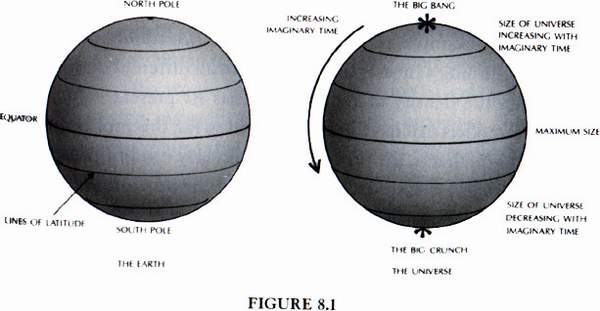 Under the “no
boundary” proposal one learns that the chance of the universe being found to be
following most of the possible histories is negligible, but there is a
particular family of histories that are much more probable than the others.
These histories may be pictured as being like the surface of the earth, with
the distance from the North Pole representing imaginary time and the size of a
circle of constant distance from the North Pole representing the spatial size
of the universe. The universe starts at the North Pole as a single point. As
one moves south, the circles of latitude at constant distance from the North
Pole get bigger, corresponding to the universe expanding with imaginary time
(Fig. 8.1). The universe would reach a maximum size at the equator and would
contract with increasing imaginary time to a single point at the South Pole.
Ever though the universe would have zero size at the North and South Poles,
these points would not be singularities, any more than the North aid South
Poles on the earth are singular. The laws of science will hold at them, just as
they do at the North and South Poles on the earth.
Under the “no
boundary” proposal one learns that the chance of the universe being found to be
following most of the possible histories is negligible, but there is a
particular family of histories that are much more probable than the others.
These histories may be pictured as being like the surface of the earth, with
the distance from the North Pole representing imaginary time and the size of a
circle of constant distance from the North Pole representing the spatial size
of the universe. The universe starts at the North Pole as a single point. As
one moves south, the circles of latitude at constant distance from the North
Pole get bigger, corresponding to the universe expanding with imaginary time
(Fig. 8.1). The universe would reach a maximum size at the equator and would
contract with increasing imaginary time to a single point at the South Pole.
Ever though the universe would have zero size at the North and South Poles,
these points would not be singularities, any more than the North aid South
Poles on the earth are singular. The laws of science will hold at them, just as
they do at the North and South Poles on the earth.
The history of
the universe in real time, however, would look very different. At about ten or
twenty thousand million years ago, it would have a minimum size, which was
equal to the maximum radius of the history in imaginary time. At later real
times, the universe would expand like the chaotic inflationary model proposed
by Linde (but one would not now have to assume that the universe was created
somehow in the right sort of state). The universe would expand to a very large
size (Fig. 8.1) and eventually it would collapse again into what looks like a
singularity in real time. Thus, in a sense, we are still all doomed, even if we
keep away from black holes. Only if we could picture the universe in terms of
imaginary time would there be no singularities.
If the universe
really is in such a quantum state, there would be no singularities in the
history of the universe in imaginary time. It might seem therefore that my more
recent work had completely undone the results of my earlier work on
singularities. But, as indicated above, the real importance of the singularity
theorems was that they showed that the gravitational field must become so
strong that quantum gravitational effects could not be ignored. This in turn
led to the idea that the universe could be finite in imaginary time but without
boundaries or singularities. When one goes back to the real time in which we
live, however, there will still appear to be singularities. The poor astronaut
who falls into a black hole will still come to a sticky end; only if he lived
in imaginary time would he encounter no singularities.
This might
suggest that the so-called imaginary time is really the real time, and that
what we call real time is just a figment of our imaginations. In real time, the
universe has a beginning and an end at singularities that form a boundary to
space-time and at which the laws of science break down. But in imaginary time,
there are no singularities or boundaries. So maybe what we call imaginary time
is really more basic, and what we call real is just an idea that we invent to
help us describe what we think the universe is like. But according to the
approach I described in Chapter 1, a scientific theory is just a mathematical
model we make to describe our observations: it exists only in our minds. So it
is meaningless to ask: which is real, “real” or “imaginary” time? It is simply
a matter of which is the more useful description.
One can also
use the sum over histories, along with the no boundary proposal, to find which
properties of the universe are likely to occur together. For example, one can
calculate the probability that the universe is expanding at nearly the same
rate in all different directions at a time when the density of the universe has
its present value. In the simplified models that have been examined so far,
this probability turns out to be high; that is, the proposed no boundary
condition leads to the prediction that it is extremely probable that the
present rate of expansion of the universe is almost the same in each direction.
This is consistent with the observations of the microwave background radiation,
which show that it has almost exactly the same intensity in any direction. If
the universe were expanding faster in some directions than in others, the
intensity of the radiation in those directions would be reduced by an
additional red shift.
Further predictions of the no boundary condition
are currently being worked out. A particularly interesting problem is the size
of the small departures from uniform density in the early universe that caused
the formation first of the galaxies, then of stars, and finally of us. The
uncertainty principle implies that the early universe cannot have been
completely uniform because there must have been some uncertainties or
fluctuations in the positions and velocities of the particles. Using the no
boundary condition, we find that the universe must in fact have started off
with just the minimum possible non-uniformity allowed by the uncertainty
principle. The universe would have then undergone a period of rapid expansion,
as in the inflationary models. During this period, the initial non-uniformities
would have been amplified until they were big enough to explain the origin of
the structures we observe around us. In 1992 the Cosmic Background Explorer
satellite (COBE) first detected very slight variations in the intensity of the
microwave background with direction. The way these non-uniformities depend on
direction seems to agree with the predictions of the inflationary model and the
no boundary proposal. Thus the no boundary proposal is a good scientific theory
in the sense of Karl Popper: it could have been falsified by observations but
instead its predictions have been confirmed. In an expanding universe in which
the density of matter varied slightly from place to place, gravity would have
caused the denser regions to slow down their expansion and start contracting.
This would lead to the formation of galaxies, stars, and eventually even
insignificant creatures like ourselves. Thus all the complicated structures
that we see in the universe might be explained by the no boundary condition for
the universe together with the uncertainty principle of quantum mechanics.
The idea that space and time may form a closed surface without boundary also has
profound implications for the role of God in the affairs of the universe. With
the success of scientific theories in describing events, most people have come
to believe that God allows the universe to evolve according to a set of laws
and does not intervene in the universe to break these laws. However, the laws
do not tell us what the universe should have looked like when it started – it
would still be up to God to wind up the clockwork and choose how to start it
off. So long as the universe had a beginning, we could suppose it had a
creator. But if the universe is really completely self-contained, having no
boundary or edge, it would have neither beginning nor end: it would simply be.
What place, then, for a creator?
<< Back