|
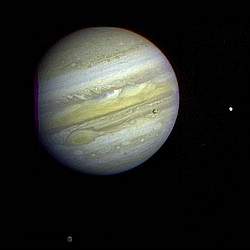
JUPITER reigns supreme among the nine planets, containing two-thirds of the planetary mass of the solar system. In composition it resembles a small star. Its interior pressure may reach 100 million times the surface pressure on Earth. Jupiter’s magnetic field is immense, even in proportion to the size of the planet, stretching million of miles into the solar system. Electrical activity in Jupiter is so strong that it pours billions of watts into Earth’s own magnetic field every day.
|
| Physical Data |
|
| Namesake | King of the Roman Gods |
|---|
| Diameter | 142.985 th. km |
|---|
| Mass | 0.0009548 (Sun=1) |
|---|
| Distance from Sun | 778.3 Million Kilometers |
|---|
Period of Revolution
(One Jovian Year) | 11.86 Earth Years |
|---|
| Rotation Period (One Jovian Day) | 9 Hours 55 Minutes |
|---|
| Albedo | 0.52 (white=1) |
|---|
| Ellipticity | 0.06481 |
|---|
| Inclination of Orbit to Ecliptic | 1.3° |
|---|
| Eccentricity of Orbit | .048 |
|---|
| Atmosphere (Main Components) | Hyrogen and Helium |
|---|
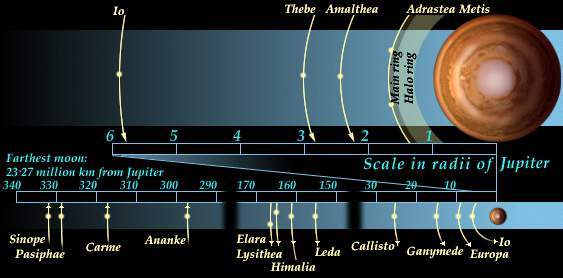
| Moons (16) In Increasing Distance from Planet: | Metis, Adrastea, Amalthea, Thebe, Io, Europa, Ganymede, Callisto, Leda, Himalia, Lysithea, Elara, Ananke, Carme, Pasiphae, Sinope |
|---|
| Rings | 1 |
|---|
| Tilt of magnetic axis | -10° |
|---|
| Offset of magnetic axis | 10% |
|---|
| Magnetic field at equator | 13.8 (Earth=1) |
|---|
| Magnetopause distance | 60-100 (radius=1) |
|---|
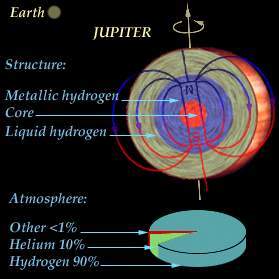
Jupiter is endowed with 16 moons, a ring system, and an immense, complex atmosphere. Its atmosphere bristles with lightning and swirls with huge storm systems, including the Great Red Spot (giant “eye-looking” feature at lower-left of image), a storm that has persisted for at least 100, and perhaps as long as 300 years. Some scientists theorize that beneath the atmosphere there is no solid mass at the center of Jupiter, but that the planet’s unique temperature and pressure conditions sustain a core whose density is more like liquid or slush.
In March 1972, NASA launched the Pioneer spacecraft to observe the asteroid belt and Jupiter. Arriving at Jupiter in December 1973, Pioneer 10 revealed Jupiter’s intense radiation output, its tremendous magnetic field, and the probability of a liquid interior. One year later, Pioneer 11 flew by Jupiter on its way to Saturn, providing even more detailed imagery and measurements, including our first close-up look at the giant planet’s polar regions. Then, in August and September 1977, NASA launched the two Voyager spacecraft to the outer solar system. The Voyagers’ 1979 encounters with Jupiter provided startling, beautiful imagery, revealing thousands of features never before seen. Swirling multicolored turbulence surrounded the Great Red Spot. Rising plumes and spinning eddies formed and dissipated, suggesting a strong source of heat bubbling up from within the planet.
Voyager imagery told us that Jovian dynamics were extremely complex. Yet many of these features resemble effects we know of in our own atmosphere, magnified by the enormity and extremity of the Jovian environment. In studying Jupiter, we can learn more about atmospheric effects and interactions that are subtle on Earth, such as magnetosphere-atmosphere interactions. Subsequent missions to Jupiter will help us understand the chemistry and behavior of Earth’s own relatively thin, but very precious, atmosphere.
Sixteen Jovian moons have been discovered. Some are icy, some rocky, some cratered, and some smooth. Io, the fifth moon from Jupiter, is actively volcanic. The Voyager flybys witnessed a total of nine spectacular volcanic eruptions, the first time any such geologic activity had been seen outside of the Earth.
The Voyagers also revealed a thin ring around Jupiter. Composed of three bands, the ring is optically dark, suggesting it is made up of impact debris. The nature and source of this ring are among the questions to be answered by subsequent missions to Jupiter.
On October 18, 1989, NASA launched the Galileo spacecraft to Jupiter. After flying by Venus and Earth (Earth twice), and passing through the asteroid belt, Galileo arrived at Jupiter and deployed a probe into the Jovian atmosphere. The probe fell for nearly an hour, revealing that Jupiter’s atmosphere is much drier than expected and does not exhibit the three-tiered cloud layers anticipated. Further, the atmosphere contained only one-half the expected helium. The probe also revealed previously unknown radiation belts and a virtual absence of lightning. Following the release of the probe, Galileo embarked on a tour of the Jovian system performing flybys of the largest moons 1000 times closer than the Voyager missions. Galileo has recorded volcanic activity on Io and revealed that the moon has an iron core almost one-half its diameter. Also, the moon Europa may have a layer of warm ice or liquid water beneath its cracked icy surface. Such observations promise to advance our understanding of small bodies of the outer solar system for decades to come.
| Significant Dates |
|
| 1610— | Italian astronomer Galileo Galilei discovered four moons orbiting Jupiter (Io, Europa, Ganymede, and Callisto-the Galilean Satellites). |
|---|
| 1973— | Pioneer 10 passed within 130,354 km of Jupiter (12/3/73); cloudtops and moons imaged. |
|---|
| 1974— | Pioneer 11 passed within 43,000 km of Jupiter (12/2/74) providing the first images of polar regions. |
|---|
| 1979— | Voyager 1 passed within 350,000 km of Jupiter (3/79) and discovered a faint ring and three moons. |
|---|
| 1979— | Voyager 2 passed within 650,000 km of Jupiter (7/79) providing detailed imagery of Jovian ring and Io volcanism. |
|---|
| 1989— | Galileo spacecraft launched (10/18/89). |
|---|
| 1995— | Galileo arrives at Jupiter (12/9/95); atmos pheric entry probe survives to pressure depth of 23 bars. |
|---|
| 1999— | Galileo orbits in Jupiter’s system, studying planet, rings, satellites, and magnetosphere. |
|---|
|